


Table of Contents
- Why Area Rug Size Makes or Breaks a Room
- How to Measure for an Area Rug Before You Shop
- Standard Area Rug Sizes and When to Use Each One
- Area Rug Placement Guide by Room
- How to Choose the Right Area Rug Size for Open Floor Plans
- Pile Height, Layering, and Other Details That Affect Perceived Size
- Visualizing Scale Before You Buy
- Conclusion
Last Updated: August 22, 2026
Why Area Rug Size Makes or Breaks a Room
The most common decorating mistake isn't a bad color choice or outdated sofa, it's an area rug that's too small for the space. A rug that floats in the center of a room makes even beautifully furnished spaces feel unfinished and spatially incoherent.
Area rug size is the foundational decision in any room layout. Get it right, and every piece of furniture looks intentional. Get it wrong, and no amount of styling fixes it. The rug defines the floor plan's anchor point, establishes visual weight, and signals where zones begin and end. In open-concept spaces, it does the work of walls.
The good news: choosing the right size is entirely learnable. Below, we'll walk through how to measure correctly, which standard dimensions suit which rooms, and the placement rules interior designers rely on. We'll also cover awkward room shapes and how pile height changes the way a rug reads in a space.
How to Measure for an Area Rug Before You Shop
Measuring for an area rug correctly means measuring your furniture grouping, not just your room dimensions. Start by identifying the furniture grouping the rug needs to anchor: in a living room, that's the sofa, chairs, and coffee table; in a dining room, the table and chairs at full extension; in a bedroom, the bed frame and nightstands.
Once you've identified the grouping, measure its total footprint and add 18 to 24 inches on each side. That buffer creates clearance for furniture legs to sit on the rug comfortably and prevents the rug from looking like an afterthought.
According to interior design guidance from the American Society of Interior Designers, spatial planning should always begin with the largest anchoring element in a room, which in most residential spaces is the primary seating or sleeping furniture.
Marking the Floor Before You Commit
Use painter's tape to mark the exact dimensions of a rug on your floor before ordering. This takes about ten minutes and eliminates guesswork entirely. Lay out the tape in the size you're considering, then step back from the room's entrance. Does it feel proportional to the furniture? Does it extend far enough past sofa legs? Aim for at least 12 to 18 inches of bare floor between the rug's border and the baseboard, which gives the room breathing room and prevents it from feeling carpeted wall-to-wall.
Accounting for Awkward or Non-Rectangular Rooms
Most area rug guides assume perfect rectangles. Few rooms actually are. For L-shaped rooms, treat each "leg" as its own zone and use separate rugs to define them. For rooms with a bay window or alcove, anchor the main furniture grouping with a standard rectangular rug and let the alcove function as negative space.
Round rugs are underused in awkward rooms. A round rug placed beneath a circular dining table or in a square entryway nook creates symmetry where a rectangle would fight the architecture.
Standard Area Rug Sizes and When to Use Each One
Standard area rug dimensions follow a consistent set of sizes. Knowing which fits which context saves significant time when shopping:
Rug Size |
Best Room Application |
Typical Use Case |
|---|---|---|
3x5 ft |
Entryway, small accent |
Landing zone at a door |
4x6 ft |
Small bedroom, office |
Under a desk or single chair |
5x8 ft |
Medium living room, bedroom |
Front feet on rug in smaller seating groups |
6x9 ft |
Mid-size living room |
Transitional sizing for tighter spaces |
8x10 ft |
Standard living room, dining room |
All feet on or front feet on larger sofas |
9x12 ft |
Large living room, open plan |
Full furniture grouping anchor |
10x14 ft |
Grand living spaces |
Formal rooms with expansive furniture |
The 8x10 is the workhorse of residential design. It works in most standard living rooms and dining rooms. The 9x12 is the upgrade for larger spaces or when you want all furniture legs fully on the rug. The 5x8 is frequently purchased for living rooms where it doesn't actually fit, if your sofa is longer than 84 inches, a 5x8 will look undersized.
Area Rug Placement Guide by Room
Placement rules vary by room because each space has a different function and relationship between furniture and floor.
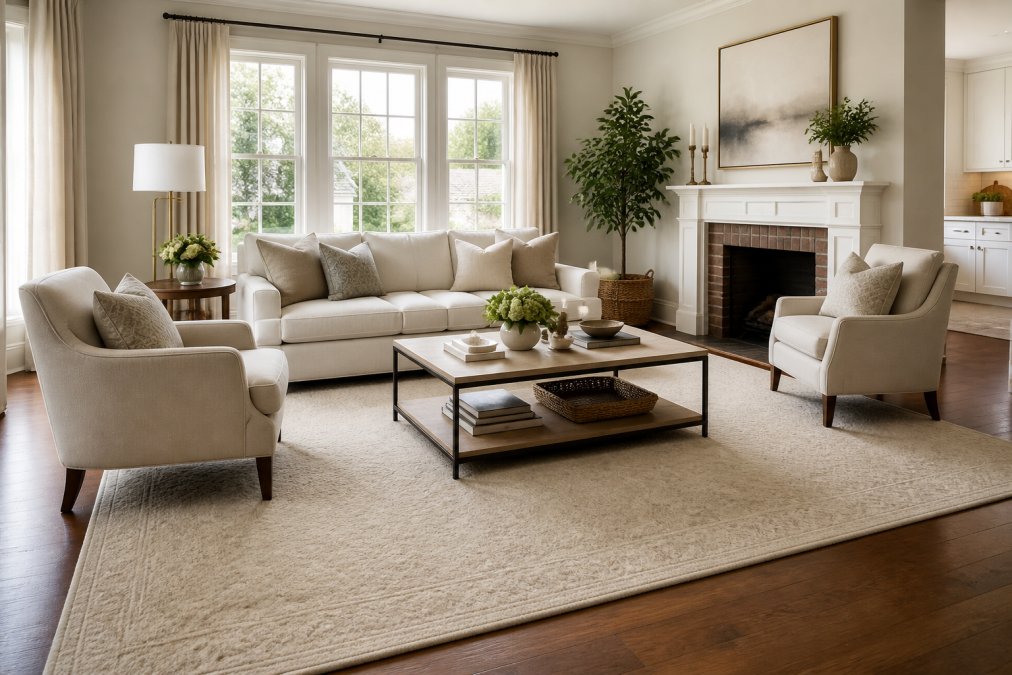
Living Room: Front Feet vs. All Feet On
Front feet on means the front two legs of the sofa and chairs rest on the rug, while back legs remain on bare floor. This works well with a 5x8 or 6x9 rug in a medium-sized room and creates visual cohesion without requiring a rug large enough for the full furniture footprint.
All feet on means every leg of every piece sits fully on the rug. This requires a larger rug, typically a 9x12 or 10x14, and produces a more grounded, formal look.
Floating furniture, where no legs touch the rug, is the configuration to avoid. For living rooms, the rug should extend at least 6 to 8 inches past the sofa on each side to maintain proportion.
Dining Room: Overhang and Chair Clearance
The dining room has a stricter rule than the living room because function drives the requirement. The rug must be large enough that chairs remain on it even when pulled out for seating. The standard recommendation is 24 inches of dining table overhang on each side. For a 36-inch wide dining table, that means a rug at least 84 inches wide. For a 72-inch long table, a rug at least 120 inches long. Most standard dining tables require at least an 8x10 rug; larger tables need a 9x12.
Round dining tables pair well with round rugs, reinforcing cohesion and making spatial planning feel deliberate.
Bedroom: Anchoring the Bed Without Overwhelming the Space
The most popular approach for a queen or king bed is to place an 8x10 or 9x12 rug so it extends 18 to 24 inches on the sides and foot of the bed, leaving the rug's top edge tucked beneath the lower third of the mattress. This grounds the bed visually and creates a soft landing for feet.
For smaller rooms or a twin bed, two matching runners placed on either side of the bed achieve a similar effect without the bulk. A third option places a single rug entirely at the foot of the bed, which works well when the floor beside the bed is already covered or when a decorative accent is the goal.
As noted in interior decorating principles from the National Trust for Historic Preservation, proportion between furnishings and floor treatments has historically been one of the defining characteristics of well-designed residential interiors.
How to Choose the Right Area Rug Size for Open Floor Plans
Open floor plans present the most challenging area rug sizing scenario because the absence of walls means rugs must do the spatial work that architecture normally handles. The principle that governs open plan rug sizing is zone definition. Each functional area, dining, seating, workspace, needs its own rug to establish where that zone begins and ends.
For the seating zone in an open plan, apply the same living room rules: front feet on or all feet on, with the rug sized to the furniture grouping rather than the total floor space. Leave deliberate negative space between rugs in an open plan, at least 18 to 24 inches between adjacent rugs prevents the space from feeling over-furnished and gives each zone visual independence.
Cohesion across multiple rugs comes from shared color palette or material family rather than matching patterns. Two rugs in complementary tones from the same design language read as intentional.
Pile Height, Layering, and Other Details That Affect Perceived Size
Pile height has a genuine impact on how a rug reads in a space. A high-pile rug with deep, plush fibers visually fills a room more than its dimensions suggest. A flatweave rug in the same size appears lighter and less dominant. This means a high-pile rug can sometimes compensate for a slightly undersized rug by adding visual mass.
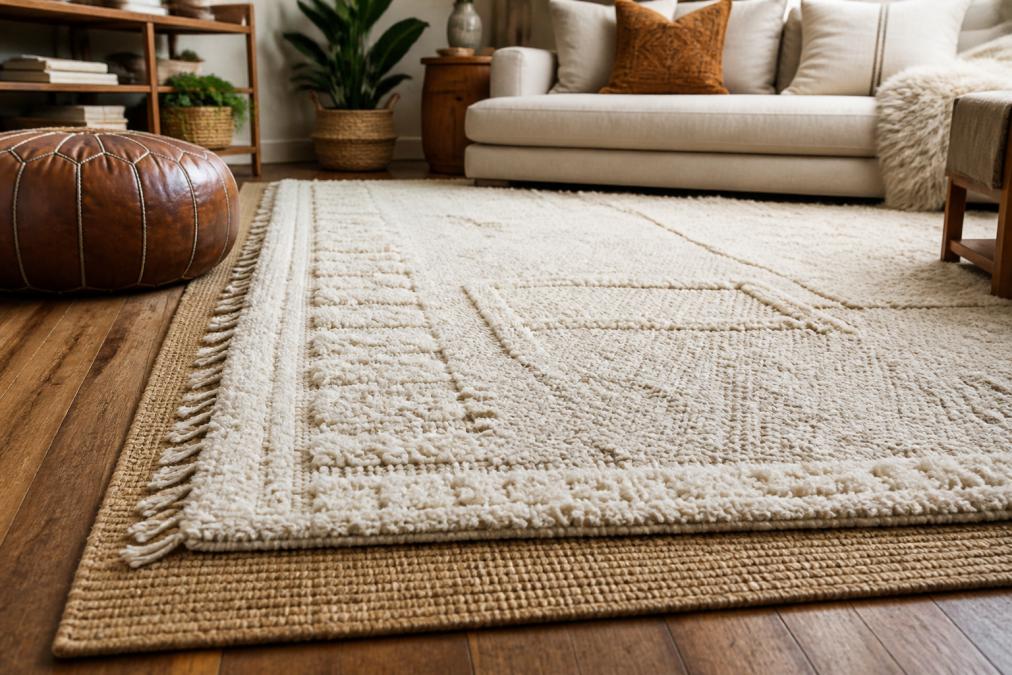
Layering rugs is one of the most effective techniques for correcting a size problem without replacing the existing rug. A smaller, textured rug layered on top of a larger flatweave base creates the impression of a custom-sized piece and adds visual interest. The base rug should be the one that satisfies the sizing rules; the layered rug adds personality and scale correction.
Practical notes on layering: the base rug should be low-pile or flatweave so the layered rug sits flat and stable; the top rug should be at least 2 to 3 feet smaller on each dimension than the base; natural fiber rugs like jute and sisal work well as base layers.
According to flooring care and rug guidance from the Carpet and Rug Institute, proper rug pad use is one of the most significant factors in long-term rug performance and floor protection.
Visualizing Scale Before You Buy
Many home decor retailers offer augmented reality tools through their mobile apps that allow you to place a virtual rug in your actual room using your phone's camera. A low-tech alternative: lay a bedsheet or large drop cloth in the approximate dimensions you're considering. For pattern-heavy rugs, photograph your existing furniture and use a photo editing app to overlay a swatch of the rug's pattern.
The Eleviq9 collection includes area rugs across the most common standard dimensions, with detailed photography that shows each rug styled in room settings rather than isolated on a white background. Seeing a rug in context, with furniture and lighting, is the closest approximation to seeing it in your own home before it arrives.
Visualizing scale is a two-step process: first, confirm the dimensions work; then confirm the visual weight works. A large, high-contrast patterned rug in a room with bold furniture can feel overwhelming even at the correct size. A neutral flatweave in the same dimensions disappears gracefully.
Choosing the right area rug size looks simple from the outside and reveals its complexity the moment you're standing in your room with a tape measure. The rules exist for good reason, but they're starting points, not rigid formulas. Eleviq9's area rug collection is curated with proportion and room cohesion in mind, offering styles that range from textural flatweaves to statement-making high-pile designs, each photographed in styled room settings so you can see the scale before you commit. Browse the collection and find the rug that anchors your space the way it deserves.
Frequently Asked Questions
What is the standard rule for area rug sizing?
The most widely used rule is to leave 18 to 24 inches of bare floor between the rug's edge and the room's walls. In a living room, the rug should be large enough for at least the front legs of every major seating piece to rest on it. Getting this proportion right anchors the furniture grouping and gives the room visual cohesion without making the space feel crowded or the rug feel like an afterthought.
Should I get an 8x10 or 9x12 rug?
An 8x10 works well in smaller living rooms and mid-size bedrooms, typically fitting rooms up to about 12x14 feet. A 9x12 suits larger living rooms and primary bedrooms where you want all four legs of a king-size bed frame sitting on the rug. When in doubt, go larger — a rug that is slightly too big reads as intentional and generous, while one that is too small makes furniture look like it is floating without purpose.
Is it better to have a rug too big or too small?
Too big is almost always the safer choice. A rug that extends generously under furniture anchors the room and creates a defined zone that feels deliberate. A rug that is too small visually shrinks the seating area, makes the room feel disjointed, and draws attention to the bare floor around it. The one exception is a very small accent rug used intentionally in an entryway or beside a bed, where the compact scale is part of the design.
How much floor space should show around an area rug?
For most rooms, 18 to 24 inches of exposed hardwood, tile, or other flooring between the rug border and the wall is the accepted standard. In smaller rooms or hallways, 12 inches can work. Showing too little floor makes the rug look like wall-to-wall carpeting; showing too much makes it look undersized. Dining rooms follow a slightly different rule — the rug should extend at least 24 inches beyond each side of the dining table to allow chairs to slide out fully without catching the edge.
This article was written using GrandRanker