
Table of Contents
- What Separates Curated Bohemian Decor from Cluttered
- High-End Boho Decor Essentials Worth Investing In
- Mixing Patterns and Textures Without Losing Cohesion
- Layering Rugs, Textiles, and Natural Fibers the Right Way
- Modern Bohemian Living Room Ideas That Actually Work
- How to Style a Boho Living Room Step by Step
- Incorporating Natural Elements and Global-Inspired Accents
- Conclusion
Last Updated: August 23, 2026
What Separates Curated Bohemian Decor from Cluttered
Bohemian decor is frequently misunderstood. Homeowners fall in love with boho-chic online, buy inexpensive pieces, and end up with a chaotic room rather than an intentional one. The difference comes down to three things: restraint, material quality, and a disciplined color palette.
The 'Cheap' vs. 'Curated' Threshold Explained
The threshold between cheap and curated bohemian decor is not about spending. It is about whether each piece earns its place in the room.
A curated bohemian space has underlying logic. Every item connects to a shared visual language: earthy tones, natural fibers, worn edges, and global-inspired forms. A cheap-looking space treats boho as a checklist, buy a dreamcatcher, add rattan, stack throw pillows. The result looks assembled rather than lived in.
The practical test: stand at the doorway and ask whether the room tells a story. Curated spaces have a clear focal point, deliberate negative space, and a sense that objects were collected over time. Cluttered spaces have no hierarchy.
Color Palette Discipline: Earthy Anchors and Saturated Accents
The biggest color mistake in bohemian decor is treating "colorful" as a strategy. Authentic boho interiors are earthy first, saturated second.
Build your palette on warm neutrals: terracotta, ochre, warm white, deep sand, and raw linen tones. These create the relaxed, unpretentious base that makes the style feel grounded. Then introduce one or two saturated accents, such as deep teal, rust red, or forest green, for visual interest without overwhelming the room.
No more than three dominant colors should appear in any single space, with earthy tones representing at least 70% of the palette. Saturated colors should appear in textiles and small decorative objects, not on large furniture or walls.
According to color theory principles from the Pantone Color Institute, warm, earthy tones create psychological comfort and groundedness, aligning precisely with bohemian design's emphasis on organic, relaxed living.
High-End Boho Decor Essentials Worth Investing In
The pieces that make a bohemian interior feel genuinely elevated are almost always the ones worth spending more on. Quality materials read as intentional, not accidental.
Material Quality Identification: What to Feel and Look For
Material quality is the single most reliable indicator of whether bohemian decor will look curated or cheap:
- Ceramics: Look for irregular surface texture, subtle color variation, and visible tool marks. Perfectly uniform surfaces indicate mass production.
- Textiles: Natural fibers like jute, cotton, and wool have visible weave variation and slightly irregular texture. Synthetic versions feel uniform and plasticky.
- Rattan and wicker: Quality rattan has a warm, honey-toned patina and surface variation. Cheap versions are often painted to hide poor construction.
- Metals: Aged brass and matte gold finishes should have depth, not a flat sheen. Spray-painted finishes read as cheap.
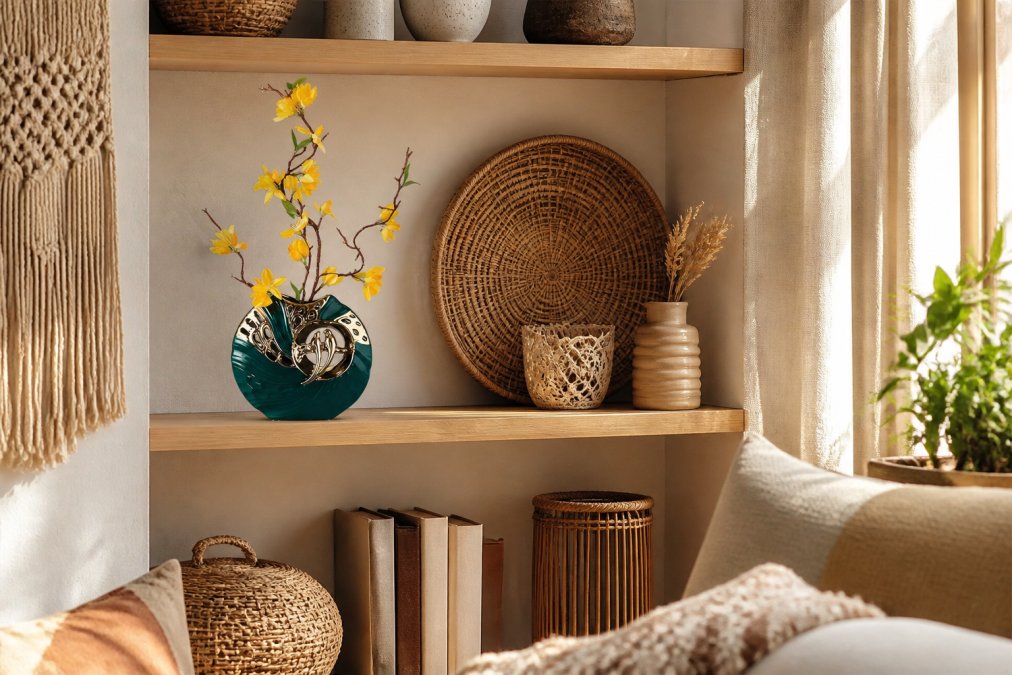
The Eleviq9 Green Gold Ceramic Vase exemplifies this principle. Its abstract lovebird design and rich green-gold tones create handcrafted-inspired character that reads as authentic. At $43.60, it delivers the visual weight of a much more expensive piece.

Statement Pieces That Anchor a Room
Every successful bohemian living room has hierarchy. One or two statement pieces carry the visual weight; everything else supports them.
Strong statement pieces include an arched gold wall mirror, a large-scale macramé panel, a vintage-inspired area rug with geometric patterns, or a low-profile sofa in textured natural fabric. The Eleviq9 Arched Gold Wall Mirror, measuring 31 x 32 inches with refined gold finish, functions as a focal point that reads as both sophisticated and authentically bohemian.
Mixing Patterns and Textures Without Losing Cohesion
The most common fear with bohemian decor is pattern mixing. People either avoid it entirely, producing a flat room, or embrace it without discipline and create visual chaos.
The rule that separates successful pattern mixing from chaos is scale variation. Pair a large-scale pattern like a bold geometric rug with a medium-scale pattern like a striped throw and a small-scale pattern like a printed cushion cover. When patterns operate at different scales, the eye reads them as layered composition rather than competing noise.
Texture works the same way. A smooth ceramic vase next to a rough-woven jute basket next to a soft faux fur pillow creates textural contrast that feels rich and intentional. The goal is a range with a shared tonal language.
As documented in interior design principles from Architectural Digest, the most successful eclectic interiors share a consistent color story even when patterns and textures vary significantly. Color is the thread that ties pattern mixing together.
The White Ceramic Donut Vases from Eleviq9, with their clean finish and sculptural form, provide textural contrast that makes compositions feel more considered when placed alongside rattan and woven textiles.

Layering Rugs, Textiles, and Natural Fibers the Right Way
Layering is the technique that most distinguishes a well-styled bohemian interior from a flat one. It creates depth, warmth, and the sense that a space has been inhabited over time.
Start with a large, neutral-toned jute or sisal base rug and layer a smaller, more patterned rug on top. The base rug grounds the space and defines the seating area; the layered rug adds pattern and color without overwhelming. Reversing this approach leaves the room feeling unanchored.
For textiles, think in terms of weight and drape. A chunky knit throw on a sofa arm, a lightweight linen cushion cover, and a faux fur accent pillow create hierarchy of texture that reads as intentional layering. The Plutus Rose Faux Fur Throw Pillow from Eleviq9, handmade in the USA from premium faux fur, adds tactile luxury that makes a boho seating arrangement feel genuinely inviting.
Natural fibers including jute, cotton canvas, macramé, and linen should appear in at least three distinct forms in any bohemian living room. When every textile is the same material and weight, the space feels one-dimensional.
Modern Bohemian Living Room Ideas That Actually Work
Modern bohemian style is the intersection of the maximalist, globally-inspired bohemian aesthetic and the cleaner lines and intentional restraint of contemporary design. The result is a space that feels layered and eclectic without feeling chaotic.
The key distinction from traditional boho is editing. Modern bohemian prioritizes fewer, higher-quality pieces over accumulation of inexpensive finds. The vibe is curated, not collected.
Low-Profile Seating and Spatial Flow
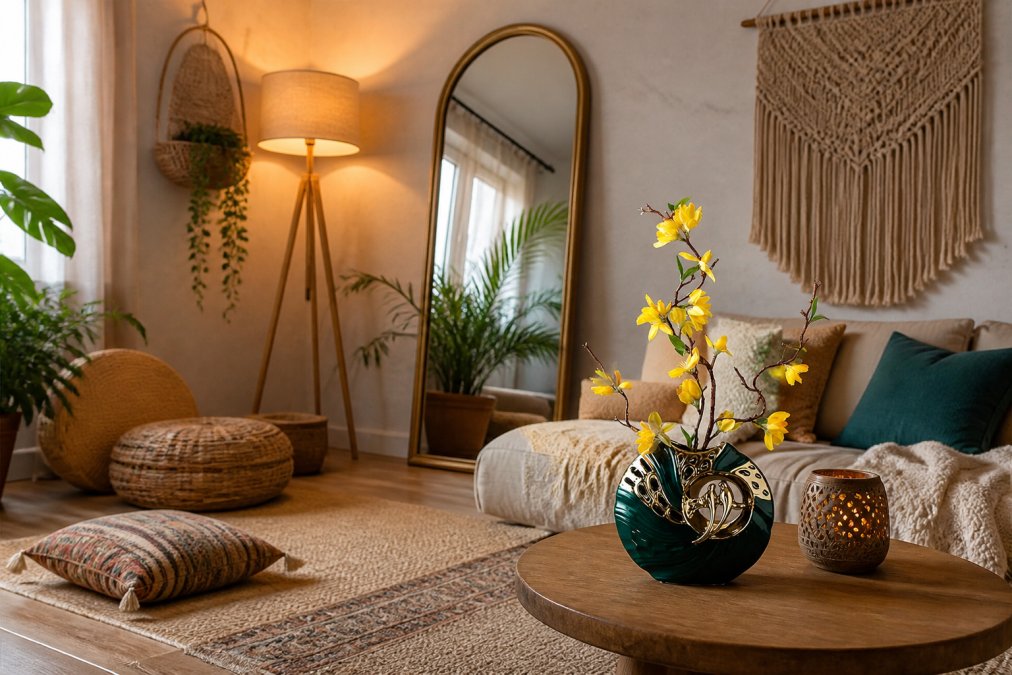
Low-profile seating is a defining feature of modern bohemian living rooms. Floor cushions, low-slung sofas, and poufs create a relaxed, horizontal visual plane that feels grounded and inviting. Clear pathways and generous negative space between furniture groupings create unhurried spatial flow.
A common mistake is filling every surface and corner. Bohemian decor thrives on contrast: a densely styled shelf next to an empty wall reads as intentional. A densely styled shelf next to another densely styled surface reads as cluttered.
Vintage Finds, Patina, and Personal Collections
Patina separates authentic bohemian decor from a staged set. Worn edges on a wooden table, irregular glaze on handcrafted ceramics, and faded tones on vintage textiles signal history and character that mass-produced pieces cannot replicate.
Personal collections, whether books, travel objects, or inherited ceramics, are the soul of a bohemian interior. Edit your collection to the visually strongest and most meaningful pieces. A shelf with five well-chosen objects communicates more than one with twenty.
Ambient Lighting and Statement Wallpaper
Ambient lighting transforms a bohemian interior more than almost any other element. Overhead lighting is the enemy of boho aesthetics. Warm, low-level lighting from floor lamps, table lamps, and candles creates the soft, layered glow that makes a space feel genuinely atmospheric.
Statement wallpaper, particularly in botanical, geometric, or globally-inspired patterns, can anchor an entire room. A single feature wall with bold pattern reads as intentional and sophisticated. Wallpaper on all four walls tends to overwhelm the textiles and objects that give the style its character.
How to Style a Boho Living Room Step by Step
Styling a boho living room is most effective when approached in a specific sequence:
- Define your color palette first. Choose two to three earthy anchor tones and one saturated accent. Every purchase decision filters through this palette.
- Select your statement piece. This is the item the room is built around: a large rug, mirror, wall art, or distinctive sofa.
- Establish your seating arrangement. Place low-profile seating to create a clear, relaxed gathering zone with generous negative space.
- Layer your rugs and textiles. Start with a large neutral base rug, add a layered rug with pattern, then introduce throws and cushions in varied textures.
- Add natural elements. Introduce plants, woven baskets, rattan accents, and natural fiber textiles. Aim for at least three distinct natural materials.
- Style your surfaces. Group objects in odd numbers, vary heights, and leave deliberate empty space between groupings.
- Set your lighting. Remove or minimize overhead lighting. Add floor lamps, table lamps, and candles for warm, ambient illumination.
- Edit. Remove anything that does not connect to at least two other elements in the room. This step is the most important.
| Step | Focus | Common Mistake |
|---|---|---|
| 1. Color palette | Earthy anchors + one saturated accent | Too many competing colors |
| 2. Statement piece | One dominant anchor item | Choosing anchor last |
| 3. Seating | Low-profile, generous negative space | Overcrowding the floor plan |
| 4. Layering | Rugs, throws, cushions in varied textures | All textiles same weight/material |
| 5. Natural elements | Three distinct natural materials minimum | Only one material type |
| 6. Surface styling | Odd groupings, varied heights | Every surface equally dense |
| 7. Lighting | Warm, ambient, low-level sources | Relying on overhead lighting |
| 8. Edit | Remove anything disconnected | Keeping everything |
Incorporating Natural Elements and Global-Inspired Accents
Natural elements are the foundation of authentic bohemian decor. The design aesthetic draws from global craft traditions, and materials like rattan, jute, clay, raw wood, stone, and cotton are all derived from the natural world.
Layer natural materials across different scales and functions. A large jute rug grounds the floor. A rattan side table adds organic structure at mid-height. A ceramic vase brings handcrafted texture to eye level. A macramé wall hanging introduces natural fiber at height. Each material occupies a different visual plane, creating depth without density.
Global-inspired accents such as Moroccan-style lanterns, hand-painted ceramics, or woven baskets add the eclectic, well-traveled quality that defines boho. Two or three globally-inspired pieces read as curated. Eight or ten read as a souvenir shop.
According to sustainable design guidance from the American Society of Interior Designers, incorporating natural and organic materials into interior spaces creates measurable improvements in perceived comfort and psychological wellbeing, reinforcing why natural elements are central to bohemian design philosophy.
Plants deserve specific attention. A bohemian interior without living plants is missing one of its most important textural and color elements. Large-scale plants like fiddle leaf figs add dramatic scale; trailing plants like pothos add softness and movement.
The distinction between a natural element that elevates a space and one that cheapens it is almost always material quality. A genuine rattan basket has warmth, variation, and character. A plastic version painted to look like rattan reads as fake immediately. Fewer genuine natural pieces always outperform more synthetic ones.
Achieving the modern bohemian look without it tipping into cheap or cluttered territory requires discipline with color, honesty about material quality, and the willingness to edit. Eleviq9 offers a curated selection of luxury home decor designed specifically for this challenge, from statement arched mirrors and handcrafted-inspired ceramic vases to premium faux fur throw pillows that add tactile richness to any layered textile arrangement. If you are building a bohemian interior that should feel sophisticated rather than assembled, browse the Eleviq9 collection and add the pieces that anchor your vision.

Frequently Asked Questions
What are the most common mistakes that make bohemian decor look cheap?
The biggest mistakes are buying too many similar low-cost items at once, skipping natural and handcrafted materials in favor of plastic or synthetic alternatives, and ignoring color discipline. Bohemian decor looks cheap when every piece competes for attention with no visual anchor. Choosing one or two quality statement pieces, a ceramic vase, a woven rug, an arched mirror, and building intentionally around them produces a curated result rather than a cluttered one.
Is bohemian decor still considered stylish for modern homes in 2026?
Yes. Modern bohemian decor, often called boho-chic, remains a strong design aesthetic in 2026, particularly as homeowners shift toward personalized, unpretentious interiors over minimalist all-white spaces. The style has matured: today's version favors quality natural fibers, vintage patina, and intentional layering over the mass-produced macramé and faded tapestries of earlier trends. When executed with discipline around color and material quality, it reads as sophisticated and timeless rather than dated.
How do you balance bohemian style with a modern, sophisticated look?
The balance comes from restraint in quantity and investment in quality. Anchor the room with one or two refined pieces, an arched gold mirror, a sculptural ceramic vase, a high-pile textural rug, then layer in global-inspired and vintage accents selectively. Keep your color palette earthy and cohesive, limiting saturated accent colors to two or three. Low-profile seating and clear spatial flow prevent the maximalist layering from tipping into visual chaos, keeping the overall design aesthetic polished.
What materials should I prioritize for high-end bohemian interiors?
Prioritize natural and handcrafted materials: jute, rattan, linen, cotton, and ceramic. These age well and develop authentic patina over time, which is central to the boho-chic aesthetic. Avoid polyester textiles as primary surfaces, reserve them for accent pillows where texture matters more than origin. For decorative objects, look for hand-thrown or handcrafted-inspired ceramics, solid wood, and metals with a warm finish. The weight, finish consistency, and tactile quality of a piece are reliable indicators of whether it will hold up or look worn in the wrong way.
This article was written using GrandRanker